
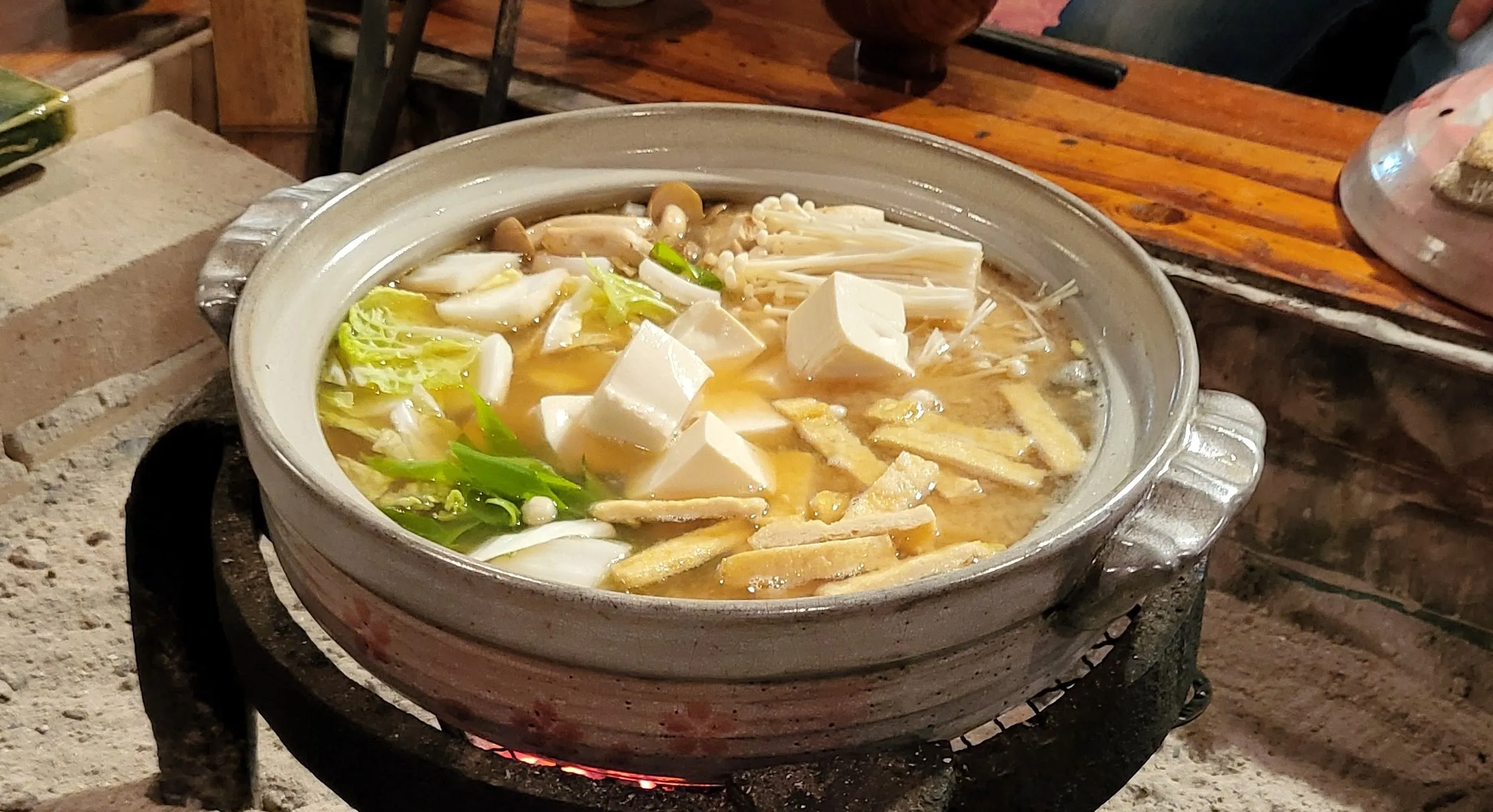
What should I actually eat?
Eat local and seasonal. Each rural region has its own specialty — soba, mountain vegetables (sansai), river fish, local beef, or a regional noodle. At inns you’ll usually get a set course of whatever is fresh; at eateries, order the dish the place is known for rather than something generic.
The real reward of a local countryside eatery is the food itself: ingredients you simply can’t get in the city, caught or picked nearby, and cooked while they’re at their freshest. This is farm-to-table (地産地消, chisan-chishō — “local production, local consumption”) in its purest form. A mountain village will do river fish and wild vegetables; a coastal town will do that morning’s catch. Ask “what’s the local specialty?” — or just order what everyone else is eating.
With a little planning, eating in the Japanese countryside becomes one of the best parts of the whole trip — a quiet set course of things you’ve never tasted, in a room looking out at the mountains or the sea. It’s worth building your day around.
How do I order without Japanese?
It depends on the place. Some have a ticket machine (食券) by the door — buy your meal there and hand the ticket over. Others have no machine and no English menu, so you order directly from a Japanese-only menu. A translation app (like Google Translate’s camera) handles the text, and “kore o kudasai” (this one, please) covers the rest.
Don’t assume every rural eatery works like a city ramen shop with a photo-covered machine. Plenty of small countryside places just hand you a Japanese-only menu, or have the day’s dishes written on the wall, and you order face-to-face. That’s where a translation app earns its place: point your phone’s camera at the menu and read the overlay, then point at what you want.
- Look for a ticket machine (
食券) by the entrance; if there is one, buy your meal ticket first. - No machine? Read the Japanese-only menu with a translation app’s camera (e.g. Google Translate).
- Order by pointing and saying
これください(kore kudasai — this one, please). - Pay in cash — many rural eateries don’t take cards.
What if I have allergies or a special diet?
Be cautious. Set meals and fish dashi are everywhere, and many small rural kitchens simply can’t adapt a dish or guarantee what’s in it. Carry a printed Japanese allergy card, ask before ordering, and if your needs are strict — vegetarian, vegan, gluten-free, severe allergies — bring some of your own food as a backup so you’re never stuck.
For inn meals specifically, state your restriction when you book, not on arrival — see the dietary section in booking a ryokan with no English website. Even then, a farmhouse inn may not be able to accommodate every request, so plan for the possibility that some meals will be off-limits.
What time do rural restaurants close?
Earlier than you think. Many rural eateries stop serving in the late afternoon, and in deep-countryside areas most places can be shut by 5pm. Miss that window and there may be nothing open for dinner. Check the closing times near where you’re staying in advance — and when in doubt, book an inn that includes dinner.
Rural Japan runs on an early schedule, and restaurants are no exception. The deeper you go, the earlier things close: in some remote areas, the last kitchen shuts around 5pm and there is no convenience store to fall back on. It’s easy to end up a “food refugee” — arriving somewhere at 7pm with everything dark.
Two habits prevent it:
- Check closing times before you go. Look up the hours of a few places near your lodging for the day you’ll be there, so you know your real dinner deadline.
- Stay somewhere that feeds you. For a night in the countryside, a
dinner-included inn (
夕食付き, yūshoku-tsuki) is the safest choice — the meal is set, seasonal, and waiting for you regardless of what’s open outside.
Where do I find good local food?
Try your inn’s dinner, roadside stations (michi-no-eki), and small family-run places over chains. Roadside stations sell local produce and cheap regional meals, and inns cook what’s in season. Where the locals eat is almost always the right answer.
Roadside stations (道の駅, michi-no-eki) are a reliable daytime option: local produce,
regional lunches, and often open when little else is. But for the evening, the countryside’s
early closing times mean your inn’s kitchen is usually both the best food and the surest bet.