
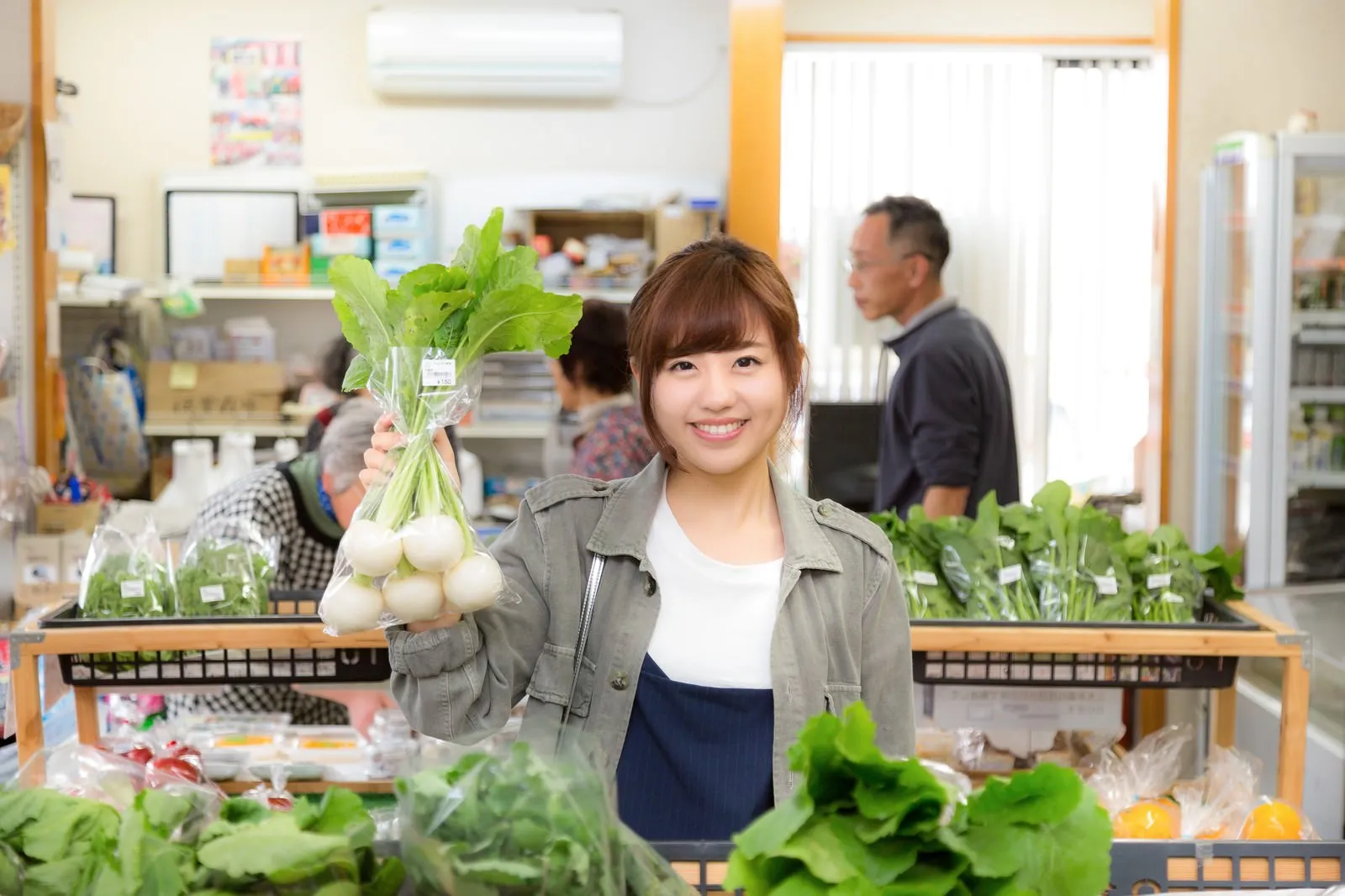
What is a michi-no-eki?
A michi-no-eki (道の駅, “road station”) is a government-registered roadside rest stop on
Japan’s rural roads. Every one has free parking and 24-hour toilets, plus a market selling
local produce and souvenirs, and most have a food court or restaurant serving regional
dishes. There are more than a thousand across the country.
Think of it as a rest area and a local farmers’ market rolled into one. Unlike a plain highway service area, a michi-no-eki is meant to showcase its region — so alongside the toilets and vending machines you’ll find that area’s vegetables, fruit, and specialty goods. For a traveler, that makes it the single easiest place to shop for local food and gifts in one stop.
The thing travelers remember most isn’t the price — it’s picking up a fruit or vegetable they’ve never seen, grown a few fields away, for a fraction of a city price. A michi-no-eki is also the easiest place to taste a whole region at once.
What can I buy there?
Fresh local produce and fruit, but also the region’s own souvenirs: jam, pickles, sauces, sweets, sake, tea, and crafts you won’t find in a city gift shop. Vegetables are often out early, and around midday you’ll usually see bento (boxed lunches) made with local ingredients.
The produce is the draw, but the region-specific souvenirs are what make a michi-no-eki worth a stop — each one carries goods particular to its area, so it’s the best place to pick up an edible gift that actually comes from where you are. A few things to know about timing:
- Vegetables and fruit appear early; the best of it is out in the morning.
- Local-ingredient bento and prepared foods usually come out around lunchtime — a great, cheap way to eat regional food on the go.
- Souvenirs and shelf-stable goods (tea, pickles, sweets) are there all day.
Where do I find farm stands and unmanned stalls?
Beyond michi-no-eki, look for two smaller options: a 直売所 (farm-direct shop) near farmland, and tiny 無人販売 (unmanned honesty-box stalls) along country lanes. Roadside stations are the biggest and most tourist-friendly; the other two are smaller, cheaper, and more local.
| Place | Japanese | What it is | Pays by |
|---|---|---|---|
| Roadside station | 道の駅 (michi-no-eki) | Large shop with produce, meals, souvenirs, toilets | Card or cash |
| Farm-direct shop | 直売所 (chokubaijo) | Local growers’ produce, staffed | Cash |
| Unmanned stall | 無人販売 (mujin hanbai) | Self-service stand with an honesty box | Cash (coins) |
Roadside stations are signposted with a blue 道の駅 mark. Farm-direct shops and unmanned
stalls you’ll mostly stumble on — keep an eye out along rural roads and near paddies.
How do I pay?
At a michi-no-eki, pay by card — Visa and Mastercard work at nearly all of them, and many also take IC transit cards or QR payment. The smaller farm-direct shops (直売所) and unmanned stalls (無人販売) are the cash-only ones, often needing exact coins.
So the payment split is simple: michi-no-eki, cards are fine; farm stands and unmanned stalls, bring cash. The unmanned stall is one of rural Japan’s small wonders — a table of vegetables, a price written on cardboard, and a slot or tin for your coins. It runs entirely on honesty, so pay the exact amount and take only what you paid for.
- Pick your produce (items are usually pre-bagged).
- Read the handwritten price — usually a flat price per bag in numerals.
- Drop the exact cash into the money box; no change is given, so bring coins.
- Take your items and bag them yourself — bring your own bag.
Because the smaller stands are cash-only, keep small change on you in the countryside — see cash, cards & country Japan.
How do I get to a michi-no-eki?
By car, ideally. Michi-no-eki are built for drivers, sitting on car routes rather than by stations, so a rental car makes them easy and fun to hop between. Without a car it’s harder — some have infrequent buses or none at all, so check public-transport access before you go.
If you’re driving, they’re a pleasure to string together, and Japan even runs michi-no-eki
stamp rallies (スタンプラリー): you collect a stamp at each station you visit. Once you
catch yourself chasing stamps from one road station to the next, you’ve officially gone
native. Not driving yet? A rental car is
the one thing that turns a michi-no-eki day from hard-to-reach into a relaxed drive — though it is worth checking whether you need one at all for the rest of your trip.
If you’re relying on public transport, treat access as the catch. Many michi-no-eki are a long way from any train line, and rural buses are limited — so look up how you’d actually reach (and leave) one before you build a day around it. See getting around rural Japan without a car.
When should I go, and what should I bring?
Go in the morning and bring your own bag. Vegetables are freshest early and the best sells out by midday, while bento appear around lunchtime. Cards work at michi-no-eki, but bring coins for smaller stands, and a cooler bag helps if you’re carrying fresh food.
A quick checklist before you set out:
- Your own bag — stalls and small shops rarely provide one.
- Coins for small stands — michi-no-eki take cards, but 直売所 and 無人販売 are cash-only.
- Go early — best produce in the morning; bento around midday; rural shops close early.
- A cooler bag — useful if you’re buying fresh food to eat later, like at your dinner-included inn or on a picnic.
One caution: fresh produce is for eating on your trip, not for taking home on the plane — Japan and your home country both restrict bringing in fruit, vegetables, and some foods. For souvenirs to fly home with, choose sealed, non-perishable local goods like tea, pickles, or crafts.